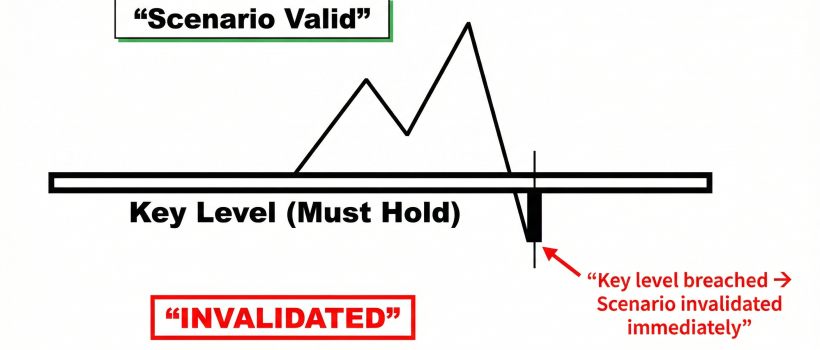
Market analysis thrives on precision, yet most analytical frameworks operate in perpetual ambiguity. Analysts revise, adjust, and reinterpret their views without ever defining the exact point where an idea stops being viable. Elliott Wave analysis, when applied correctly, functions differently. It operates on invalidation—a concept that separates structured analysis from speculation.
In Elliott Wave analysis, invalidation defines the exact point at which a market scenario becomes structurally impossible. It is a rule-based boundary that determines whether a wave count remains valid or must be discarded.
Invalidation is not a failure. It is a boundary condition. It is the predetermined point at which a specific wave count scenario is no longer structurally possible under Elliott Wave rules. Understanding invalidation transforms Elliott Wave from a forecasting exercise into a rule-based decision framework.
What Is Invalidation in Elliott Wave Analysis?
Invalidation occurs when price action violates a structural rule that defines a specific Elliott Wave scenario. It is a boolean outcome: a wave count is either valid or it is not. There is no middle ground.
In Elliott Wave theory, certain patterns have non-negotiable rules. For example, in a five-wave impulse structure, Wave 4 cannot overlap Wave 1 in price. If price moves into the range of Wave 1 during what was labeled as Wave 4, that impulse count is invalidated. The scenario terminates immediately. The analysis does not become “less likely”—it becomes impossible.
This is distinct from confidence. An analyst may hold low confidence in a scenario while it remains technically valid. Conversely, an analyst may have high confidence in a scenario until price action invalidates it in a single move. Invalidation is structural, not probabilistic.
Most market participants encounter Elliott Wave through content that avoids stating invalidation levels. Counts are presented with optimism but no termination conditions. When price moves against the analysis, the count is quietly revised. This approach treats Elliott Wave as a narrative tool rather than a rule-based framework. It is why many traders view Elliott Wave as subjective or unreliable.
In reality, subjectivity exists in choosing which scenario to prioritize. Invalidation, however, is objective. If a rule is broken, the count fails. This separation—between interpretive choice and structural failure—is where disciplined Elliott Wave analysis begins.
Why Invalidation Matters More Than Prediction
Prediction implies certainty about future outcomes. Invalidation defines boundaries around present structure. The difference is foundational.
When an analyst predicts that a market “will rise to a target,” they create an expectation. If the market does not reach that target, the prediction was wrong, but there is no formal mechanism to determine when the idea failed. The analyst can indefinitely claim the move is “delayed” or “still developing.” There is no accountability because there was no boundary.
Invalidation enforces accountability. If a wave count scenario has a defined invalidation level, the market either respects that boundary or it does not. If invalidation occurs, the scenario is removed from consideration. The analyst must move to an alternate structure or acknowledge that no clear count is available.
This is why invalidation-driven analysis is more rigorous than prediction-based analysis. It does not require the analyst to be correct about future price movement. It requires the analyst to know when their current structural interpretation has failed.
Consider two approaches:
Approach A (Prediction-focused):
“The market is likely in a bullish Wave 3. Expect continuation toward higher levels.”
Approach B (Invalidation-focused):
“The current structure is labeled as Wave 3 of an impulse. This count remains valid as long as price holds above the Wave 1 high. If price moves below that level, the impulse structure is invalidated and an alternate count applies.”
Approach A provides no decision framework. Approach B establishes a condition. The user knows exactly when the scenario fails and can plan accordingly.
This is the essence of invalidation: it converts Elliott Wave from a forecasting method into a conditional logic system. The question is not “where will price go?” but rather “under what conditions does this structural interpretation remain possible?”
This distinction becomes clearer when Elliott Wave
is viewed not as a predictive tool,
but as a rule-based structural framework.
(See: Elliott Wave Is Not Prediction — how structure replaces forecasting)
What Is the Difference Between Invalidation and Confidence Loss?
Invalidation and confidence are independent variables. This distinction is critical and widely misunderstood.
Confidence represents the analyst’s subjective assessment of how well a scenario fits the available data. It is influenced by wave proportions, momentum behavior, volume patterns, and context. Confidence can increase or decrease as new price action develops. It is fluid.
Invalidation is binary. A scenario is either structurally intact or it is not.
An analyst may assign low confidence to a scenario that remains technically valid. For instance, a wave count might satisfy all Elliott Wave rules but exhibit poor proportions or weak momentum. The analyst recognizes the count as possible but unlikely. Confidence is low. Invalidation has not occurred.
Conversely, an analyst may hold high confidence in a scenario until a single price move breaks a structural rule. The invalidation is immediate and absolute, regardless of prior confidence. The scenario is no longer viable.
This separation allows for rigorous scenario management. In practice, analysts often track multiple scenarios simultaneously: a preferred count with higher confidence and one or more alternate counts with lower confidence. Each scenario has its own invalidation level. As price develops, some scenarios invalidate while others gain or lose confidence.
The failure to distinguish between confidence and invalidation leads to a common error: treating invalidation as a probabilistic threshold rather than a rule violation. Analysts sometimes describe a count as “invalidated” when they simply mean it has become less likely. This dilutes the concept. Invalidation is not a judgment call. It is a mechanical outcome.
Precision in language matters. When a count is invalidated, it is no longer part of the analysis. When a count loses confidence, it remains structurally possible but deprioritized. These are different states and should be treated as such.
Why Is Invalidation a Boolean Rule in Elliott Wave Analysis?
Markets do not move in straight lines. They produce noise, corrections, and ambiguous sequences. Elliott Wave analysis, as a pattern-recognition framework, must contend with this complexity. Invalidation provides clarity within that complexity by establishing hard boundaries.
A boolean rule is one that has only two states: true or false. In Elliott Wave, invalidation functions as a boolean rule. Either the price action permits the scenario (true) or it does not (false). This binary nature is what allows Elliott Wave to function as a structural framework rather than a descriptive narrative.
For example, an impulse wave must contain five sub-waves. Wave 3 cannot be the shortest of Waves 1, 3, and 5. Wave 2 cannot retrace more than 100% of Wave 1. These are not guidelines—they are requirements. If any of these conditions are violated, the impulse count is invalidated.
The boolean nature of invalidation enables scenario-based analysis. An analyst does not need to choose one “correct” count. Instead, they map out multiple structurally valid interpretations, each with explicit invalidation levels. As price develops, scenarios invalidate one by one until only a subset remains viable.
This approach mirrors conditional logic in programming: “If this happens, then this structure is possible. If that happens, the structure is impossible.” The market provides data, and the Elliott Wave rules process that data into structural conclusions.
In markets characterized by high volatility or low liquidity, invalidation becomes even more valuable. When price action is erratic, subjective confidence becomes unreliable. A move that “feels wrong” may still be structurally valid. A move that “looks right” may violate a rule. The boolean nature of invalidation removes emotional interpretation from the decision process.
Why Most Elliott Wave Content Avoids Invalidation
The majority of publicly available Elliott Wave analysis does not clearly state invalidation levels. There are several reasons for this, none of them related to the validity of the framework itself.
First, invalidation exposes the analyst to accountability. If an invalidation level is stated and then breached, the scenario has definitively failed. There is no ambiguity. For content creators who prioritize appearing correct, this is a liability. It is safer to present a directional bias without specific boundaries, allowing for post-hoc revision when the market moves against the analysis.
Second, invalidation requires commitment to a specific wave count structure. Many Elliott Wave practitioners present counts as tentative suggestions rather than structured scenarios. This hedging is often framed as humility, but it undermines the framework’s utility. Elliott Wave rules are strict. If an analyst is unwilling to commit to a structure, they cannot define where that structure fails.
Third, invalidation-focused analysis serves a different audience. Casual market observers want predictions and price targets. Serious market participants want decision frameworks. Content optimized for engagement often prioritizes the former. Content optimized for utility prioritizes the latter.
Fourth, defining invalidation requires deeper understanding of Elliott Wave rules. It is not sufficient to recognize patterns visually. The analyst must understand which rules apply to which patterns and how those rules translate into price levels. This demands more rigor than general commentary.
The result is a landscape where Elliott Wave is commonly associated with flexibility and subjectivity, when in fact the framework is built on rigid rules. The perception problem is not inherent to Elliott Wave—it is a byproduct of how the framework is commonly presented.
Professional analysis survives by knowing when it fails. Invalidation is the mechanism that makes this possible.
Invalidation as the Foundation of Scenario-Based Analysis
Elliott Wave analysis, applied correctly, is not a single-path forecast. It is a mapping of possible structural interpretations, each with defined conditions for continuation and termination. In real-world market analysis, this logic becomes most apparent when tracking live structures over time, where scenarios persist until invalidated rather than revised.
A scenario-based approach begins with the recognition that markets can unfold in multiple ways, all of which may be structurally valid at a given moment. The analyst’s role is not to predict which scenario will occur but to define what each scenario requires and when each scenario fails.
Each scenario is assigned an invalidation level based on the Elliott Wave rules governing its structure. As price action develops, some scenarios invalidate. The remaining scenarios become more probable by process of elimination, not because they were “predicted” but because alternatives were ruled out.
This creates a dynamic analytical framework. The analyst does not need to be correct about the future. They need to be correct about structure. When a scenario invalidates, the framework adjusts. There is no need to defend a prior view or rationalize why the market “should have” moved differently. The rules provide the answer.
Invalidation also serves as the natural transition point between scenarios. When a preferred count invalidates, an alternate count—previously tracked but deprioritized—becomes the new reference structure. This transition is seamless because both scenarios were defined in advance, each with its own invalidation level.
This is how invalidation transforms Elliott Wave from a subjective exercise into a logical system. The subjectivity lies in choosing which scenario to prioritize, not in determining when a scenario has failed.
Summary: Structure Over Outcome
Invalidation is not about being right or wrong. It is about knowing when a structural interpretation is no longer viable.
Elliott Wave analysis, when grounded in invalidation, becomes a rule-based decision framework. Scenarios remain active until they are invalidated. Analysts manage multiple possibilities, update based on structural termination, and avoid the trap of defending predictions.
Markets do not reward certainty. They reward adaptability within structure. Invalidation provides that structure.
Understanding invalidation is the prerequisite for understanding Elliott Wave as a professional tool rather than a forecasting gimmick. It is the boundary that separates analysis from speculation.
Elliott Wave invalidation only makes sense when the framework itself is understood as structure, not prediction.
If you want to understand why Elliott Wave analysis does not attempt to forecast price outcomes—and why invalidation is central to its discipline—read: Elliott Wave Is Not Prediction: A Rule-Based Market Structure Framework.
Real-World Invalidation Example
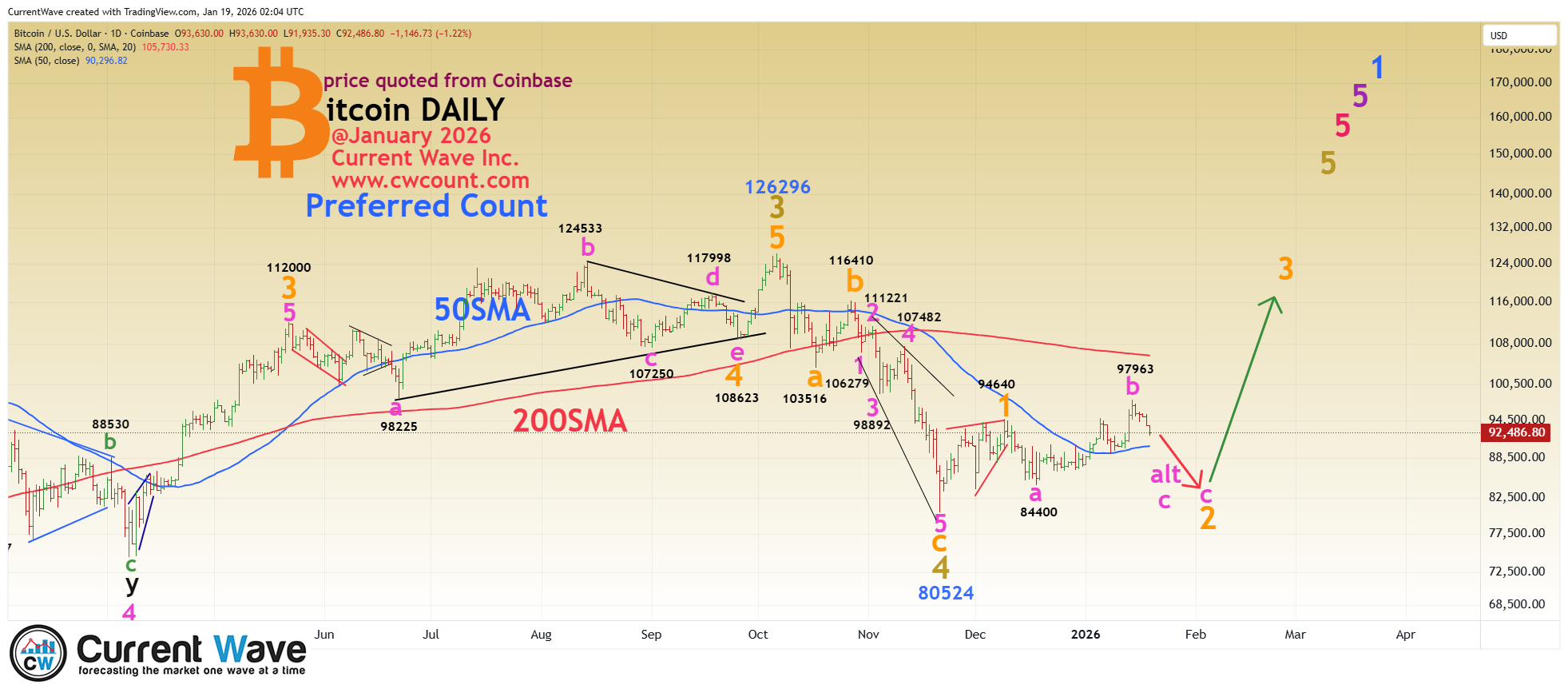
Figure 1.
Daily chart published on January 19, 2026.
At this point, the market was interpreted as unfolding an orange-degree corrective structure, with 81,000 defined in advance as the invalidation boundary. No directional outcome was assumed.
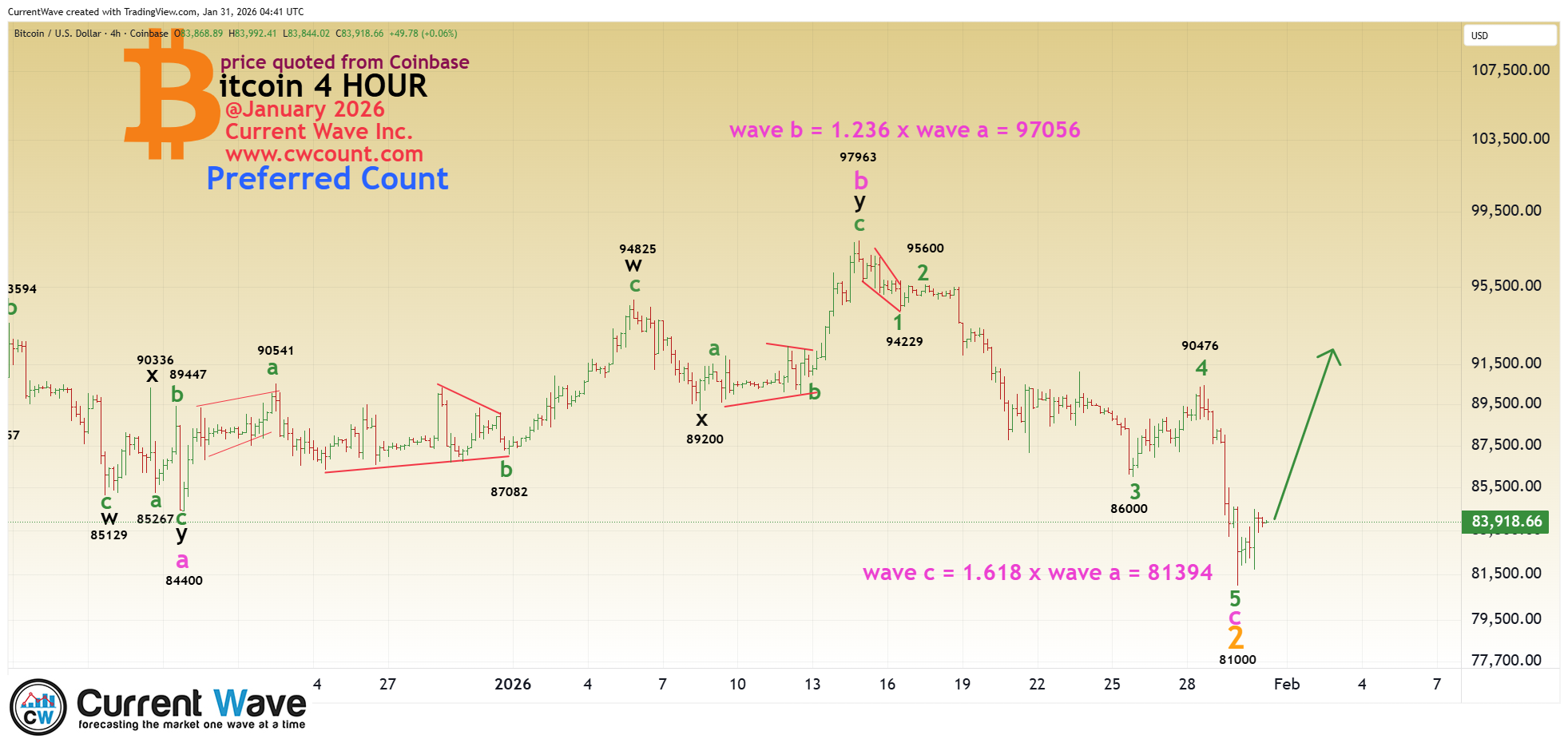
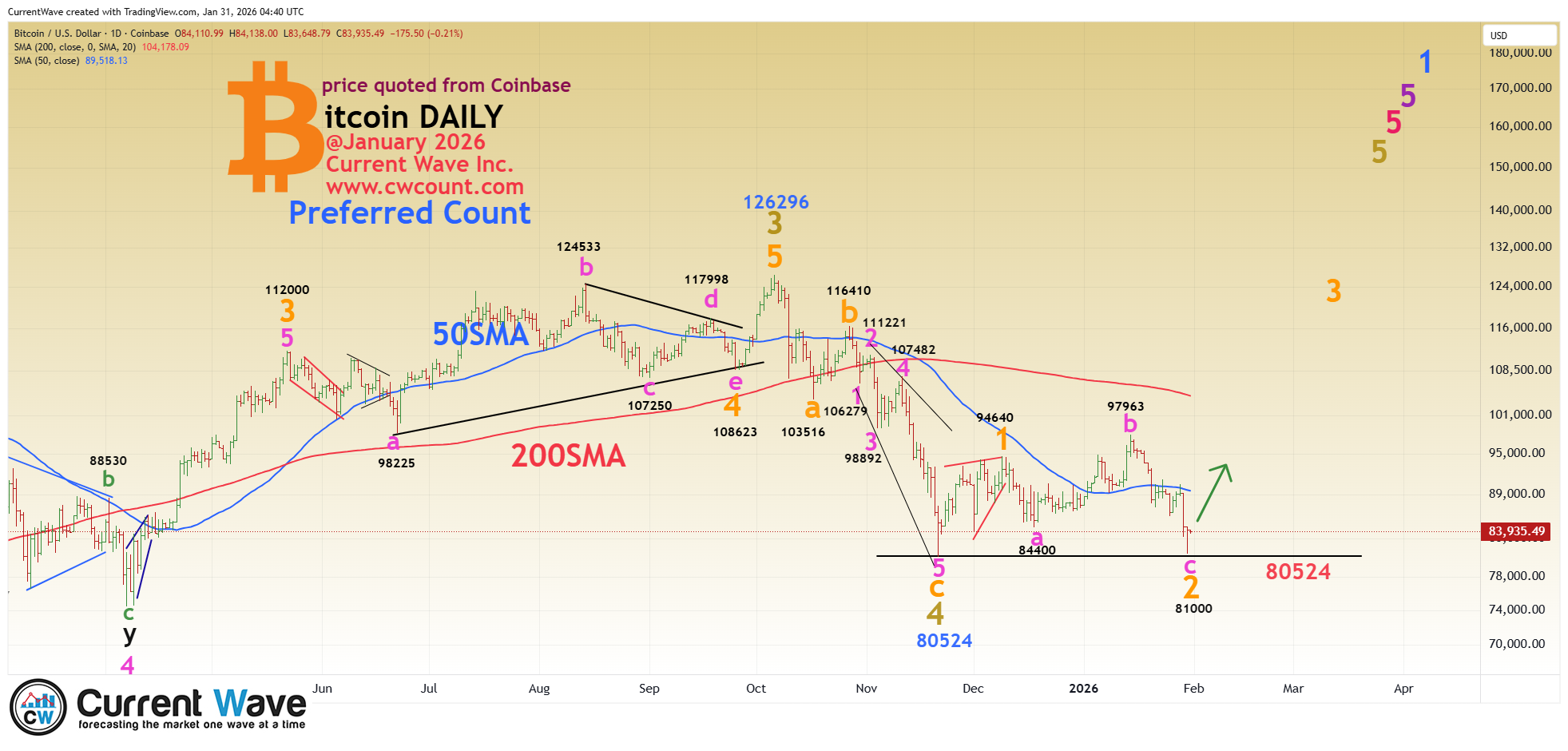
Figure 2.
Subsequent daily price action as of January 31, 2026, evaluated against the same structural framework. The analysis remained unchanged until the invalidation condition was met.
From a validation perspective, the 81,000 level was defined in advance
as the hard structural boundary for the preferred interpretation.
When price decisively breached this level, the prior ABC interpretation was invalidated. This breach confirmed that the correction had not yet completed at the 4th gold minor degree.
As a result, the structure was reclassified as an ongoing
minor gold wave 4, rather than a completed corrective sequence.
This sequence illustrates that the structure was defined before the outcome, and resolved only after the invalidation condition was met.
The breach confirmed that the market was still unfolding a corrective process, not transitioning into a new impulsive phase.
FAQ
What does invalidation mean in Elliott Wave analysis?
In Elliott Wave analysis, invalidation refers to the exact point
at which a market scenario becomes structurally impossible under Elliott Wave rules.
It is not a subjective judgment or a loss of confidence.
Invalidation occurs when price action breaks a non-negotiable rule,
such as violating a key level that must hold for the structure to remain valid.
Once invalidation occurs, the scenario is immediately discarded.
Is invalidation the same as being wrong in Elliott Wave analysis?
No. Invalidation is not the same as being wrong.
Being wrong implies a failed prediction.
Invalidation simply means that a specific structural scenario has ended.
Elliott Wave analysis is scenario-based.
When one scenario invalidates, alternate scenarios may still remain valid.
The analysis continues — only the invalidated structure is removed.
Why are key levels so important in Elliott Wave analysis?
Key levels represent hard structural boundaries, not reference zones.
In Brian Kim’s Elliott Wave methodology,
a key level must be respected for a scenario to remain valid.
If price — including the wick — breaches that level,
the scenario is invalidated immediately.
Key levels are not flexible and are not adjusted after the fact.
They exist to define when a structure survives and when it fails.
Why do many Elliott Wave analysts avoid defining invalidation levels?
Because defining invalidation levels introduces accountability.
Once an invalidation level is stated,
the scenario has a clear failure condition.
If that level is breached, the count cannot be defended or revised.
Many Elliott Wave analyses avoid this by presenting directional bias
without explicit structural boundaries,
which turns Elliott Wave into a narrative rather than a rule-based framework.
Can a scenario lose confidence without being invalidated?
Yes. Confidence and invalidation are independent.
Confidence reflects how well a scenario fits supporting factors
such as proportions, momentum, or market context.
It can increase or decrease over time.
Invalidation, however, is binary.
A scenario is either structurally valid or it is not.
As long as the key level holds, the structure remains valid —
regardless of confidence.
For a broader explanation of how CWCOUNT applies Elliott Wave
as a rule-based market structure framework,
visit the Education Center.