
Understanding Bitcoin’s Deep Corrections Through Elliott Wave Theory
Bitcoin Elliott Wave: Why Deep 4th Waves Are Not an Anomaly
One of the most common mistakes investors make is assuming that sharp corrections are aberrations—unexpected events that somehow “should not have happened.”
In reality, markets rarely behave randomly. Across stocks, bonds, indices, commodities, and cryptocurrencies, price structures tend to repeat, especially during trending phases.
Bitcoin is no exception.
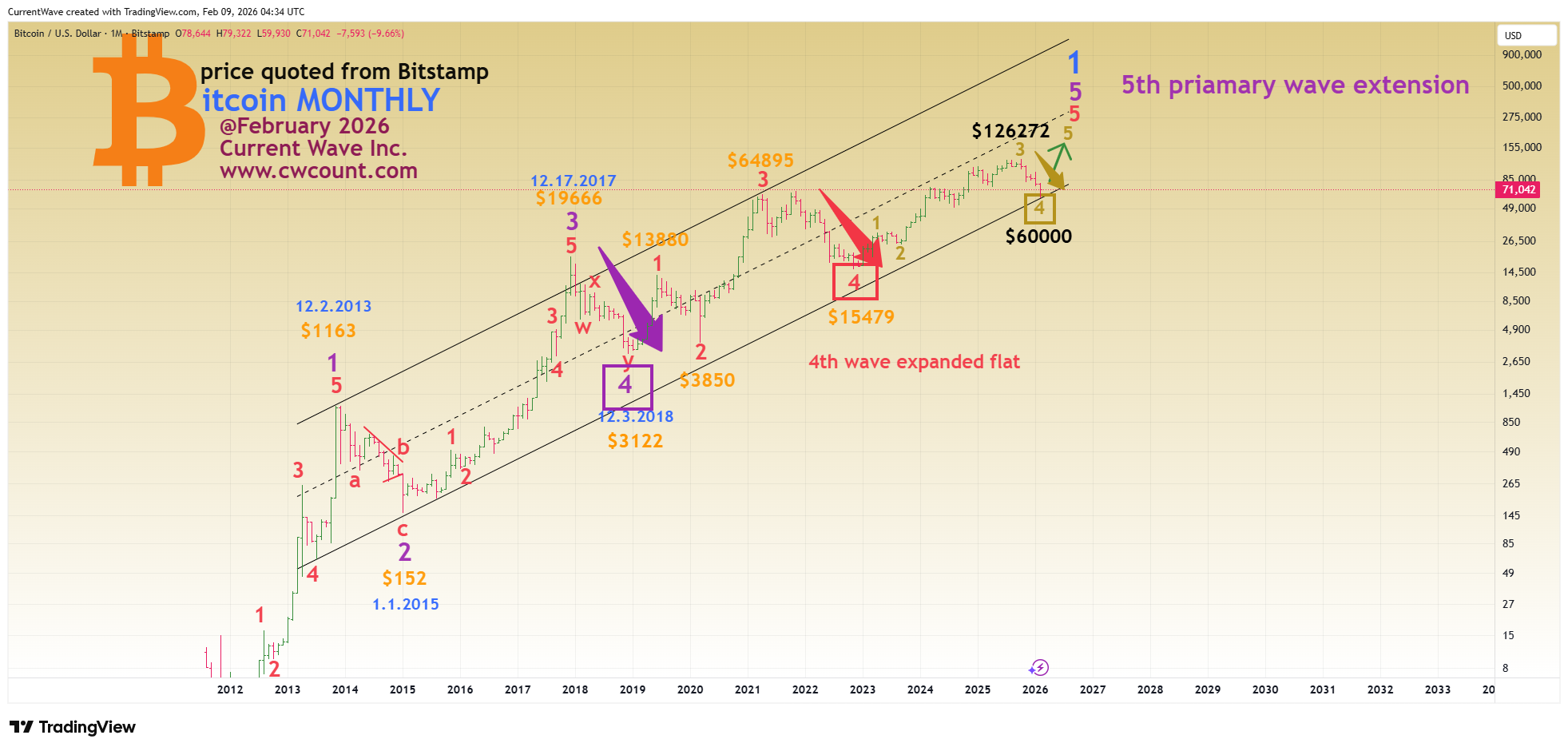
The monthly chart attached above provides a clear historical context for understanding Bitcoin’s recent decline, particularly when viewed through the lens of Elliott Wave Theory and more specifically, the behavior of 4th waves.
When a fourth wave becomes deeper than expected,
the real question is not whether the correction feels uncomfortable,
but whether the wave structure has been invalidated.
The Nature of the 4th Wave in Trending Markets
In Elliott Wave Theory, 4th waves are corrective phases that occur after a strong impulsive advance. They serve a structural purpose:
– releasing excess momentum
– resetting sentiment
– preparing the market for the next impulsive leg
Their depth and complexity depend on the broader trend, volatility regime, and prior wave extensions. In strong secular trends, 4th waves are often:
– deeper than expected
– sideways or complex
– emotionally difficult, shaking out late participants
Bitcoin’s Repeating 4th-Wave Structure on the Monthly Chart
When we examine Bitcoin’s monthly chart, a consistent pattern emerges:
– The primary 4th wave (purple) was deep and complex
– The intermediate 4th wave (red) followed a similar corrective profile
– The minor 4th wave (gold) also retraced sharply
These corrections were not isolated events. They occurred within a clearly defined upward trend channel and followed prior wave extensions—exactly what Elliott Wave theory would anticipate.
This alignment across multiple degrees strongly suggests that Bitcoin’s recent correction:
– was structurally consistent
– followed historical precedent
– was not an anomaly
In other words, what we are witnessing now is not a breakdown of the trend, but a repetition of it.
Frequently Asked Questions
Are deep Bitcoin corrections abnormal?
No. Historically, Bitcoin has experienced deep 4th-wave corrections across multiple degrees within long-term uptrends.
Why are 4th waves often deep in strong trends?
They release excess momentum, reset sentiment, and prepare the market for the next impulsive move.
Does a deep 4th wave mean the trend is broken?
No. In many cases, it reflects a repetition of prior structural behavior rather than a trend failure.
If deep corrections continue to create confusion,
the solution is not better prediction —
it is consistent invalidation tracking.