Timestamped Case Reviews with Defined Invalidation Levels
CWCOUNT is a crypto-focused Elliott Wave forecast and market structure analysis service led by Brian Kim, using timestamped chart records, preferred and alternate scenarios, invalidation levels, and outcome reviews to evaluate Bitcoin and crypto market structure.
The purpose of this page is not to claim prediction accuracy. It is to show how each scenario was framed — with defined levels, preferred and alternate counts, and honest outcome reviews. In Elliott Wave analysis, structure matters more than any single call.
All items reflect probability-based structural analysis, not guarantees. 가능성이며 단정은 아닙니다.
How to Read These Case Studies
- Preferred count / alternate count
- The preferred count is the scenario the analysis considers most probable at the time; the alternate is the competing scenario. Both are always defined, and the analysis states in advance which price levels would shift weight from one to the other.
- Invalidation level
- The price at which the analysis declares itself wrong — defined before the outcome, not after. If price crosses it, the count is reassessed. This is the core of structure-based analysis: every scenario carries its own failure condition.
- Verdict scale — Confirmed / Partial / Open
- Partial means the direction and key level reactions materialized, but the larger structure was not complete at review time, so no stronger claim is made. A case is only marked Confirmed when the full sequence resolves. Every case below is Partial — deliberately conservative.
- Color labels (purple, pink, orange, green, gold, burgundy)
- CWCOUNT charts mark wave degree — the size and time scale of each wave — with colors. Larger degrees (purple, pink) span weeks to months; smaller degrees (green, gold) span days. The full system is explained in the Education hub and Elliott Wave Theory pages.
- How each case is laid out
- Chart (timestamped at publication) → the commentary exactly as written at the time → what price actually did → verdict. The quotes are reproduced verbatim so the record can be checked against the original posts.
Why We Publish Partial Verdicts
In Elliott Wave analysis, a scenario can develop in the expected direction without every part of the larger structure being complete. For that reason, CWCOUNT uses Partial when the main structural path has developed as framed, but the full higher-degree sequence still requires further confirmation.
A Partial verdict does not mean the analysis failed. It means the review is limited to what the timestamped record can support. If a downside scenario moved through the defined trigger levels but the final wave sequence remained unfinished, the review should say so. If a completion or review zone was reached but the next larger structure was still developing, the verdict should not overstate the result.
This conservative standard is important for three reasons. First, it separates directional development from structural completion. A market may move into the expected zone while the larger wave count still needs more price action to resolve. Second, it keeps the review tied to the original evidence. Each case is evaluated using the levels, wording, and chart structure that were available at the time, not by rewriting the scenario after the fact. Third, it preserves the role of invalidation and reassessment. Elliott Wave work is not only about a preferred count. It is also about knowing when a count must be adjusted, when an alternate count becomes more relevant, and when a level changes the interpretation.
For these reasons, every case on this page is labeled Partial. The goal is not to present finished certainty. The goal is to show how a probability-based structural method was recorded, monitored, and reviewed.
What an Invalidation-First Method Looks Like
A structure-based method begins with a preferred count, but it does not end there. Every meaningful scenario needs a point at which the analyst must admit that the preferred interpretation needs to change. This is why invalidation and reassessment levels matter. They are not decorative numbers on a chart. They define the boundary between one interpretation and another.
In the Bitcoin sequence, this principle appeared before the May–June decline became fully visible. On April 14, the previous correction count was publicly marked invalidated after price moved beyond the prior purple B high at 76,022. That change did not weaken the method. It showed the method working: when the market moved beyond the boundary of the prior interpretation, the count had to be revised.
The same discipline appeared again on June 27. The preferred count was described as beginning to lose its right look if the expected series of third waves failed to accelerate lower. This is another form of structural honesty. Instead of forcing the preferred count to remain valid at all costs, the review acknowledged that continued sideways action could increase the probability of an alternate interpretation.
This is the purpose of an invalidation-first method. It does not depend on one fixed outcome. It defines the preferred path, identifies the conditions that would weaken it, and preserves an alternate scenario when the market structure changes.
The first Bitcoin case shows how a larger market view can be broken into smaller structural checkpoints. Rather than relying on one broad statement, the sequence used separate levels to track whether the downside scenario was gaining confirmation.
The May–June 2026 Downside Sequence
In early May 2026, with Bitcoin trading near 81,000 USD, CWCOUNT’s preferred count framed a larger corrective decline through three timestamped checkpoints.
May 6 — The Conditional Trigger

Original commentary · May 6, 2026
“Identifying the top of primary purple wave B has proven to be particularly challenging. We have therefore readjusted the internal wave structure to reflect the possibility that 82,814 marked the completion of the entire pink wave B correction. If price action decisively breaks below 78,073, it would strongly confirm that the primary purple wave C decline is underway.“
May 8 — The Monthly Structure

Original commentary · May 8, 2026
“Against 82814, our focus remains lower in 5 red intermediate waves to complete primary purple wave C. For now, we believe the current price action is tracing out the 1st orange wave of the 1st minor gold wave decline.”
May 12 — The Third-Wave Setup

Original commentary · May 11, 2026
“So far, the price action appears to be unfolding as the 1st and 2nd green waves, with the 2nd green wave correction tracing out an expanded flat pattern. If this interpretation is correct, the market should soon transition into a stronger impulsive decline as the 3rd green wave begins to unfold.”
IN PLAIN TERMS — In early May, with Bitcoin near $81,000, the analysis said: if price falls below 78,073, expect a much larger decline toward the 60,000 area shown on the monthly chart. Price broke that level and fell to about 59,100 within a month. The monthly levels (63,136 / 60,000) described where the decline could pause and be reviewed — zones to watch, not exact targets.
Key levels in this case
60,000 / 63,136 — wave-2 completion/review zone
80,273 — wave-2 support / bearish transition level
VERDICT · PARTIAL
Bitcoin broke below the May 6 downside confirmation trigger and later moved through the May 12 bearish transition level, declining into the 59,073–60,000 review area through June 2026 and touching approximately 59,100 on June 5. The downside direction and level reactions materialized; as of July 2026 the larger wave-2 structure remains in progress, so full completion is not claimed.
After the May–June downside sequence reached the 59,073–60,000 review area, the next question was no longer only whether Bitcoin had moved lower. The focus shifted to how the internal structure should be reviewed around a prior low and what would confirm the next wave interpretation if that level were reclaimed.
59,073 as a Structural Reference

Original commentary · June 22, 2026
“The continued strength in the price action suggests the internal wave structure needs to be revised to a simple ABC correction, with pink wave A unfolding as a leading diagonal. If this interpretation is correct, then wave C should subdivide into five green waves to complete orange wave 2.”
59,073 functions as a prior-low reference that also serves as a confirmation trigger if reclaimed — a decisive move back above it would confirm the fifth-wave count.
IN PLAIN TERMS — 59,073 is the June low on the chart, and it matters in both directions: it marks where the decline paused, and a decisive move back above it would confirm the next stage of the count. Until that happens, it is a reference point to monitor — not a signal to act on.
Key levels in this case
VERDICT · PARTIAL
The downside structure materialized into this zone; the final five-wave sequence was incomplete at review time.
The XRP case applies the same method to a different asset and a different structure. Instead of a Bitcoin monthly review zone, XRP centered on a triangle peak, a developing fifth-wave decline, and a defined reassessment threshold.
A Bearish Structure with a Defined Reassessment Threshold
April 4 — The Setup
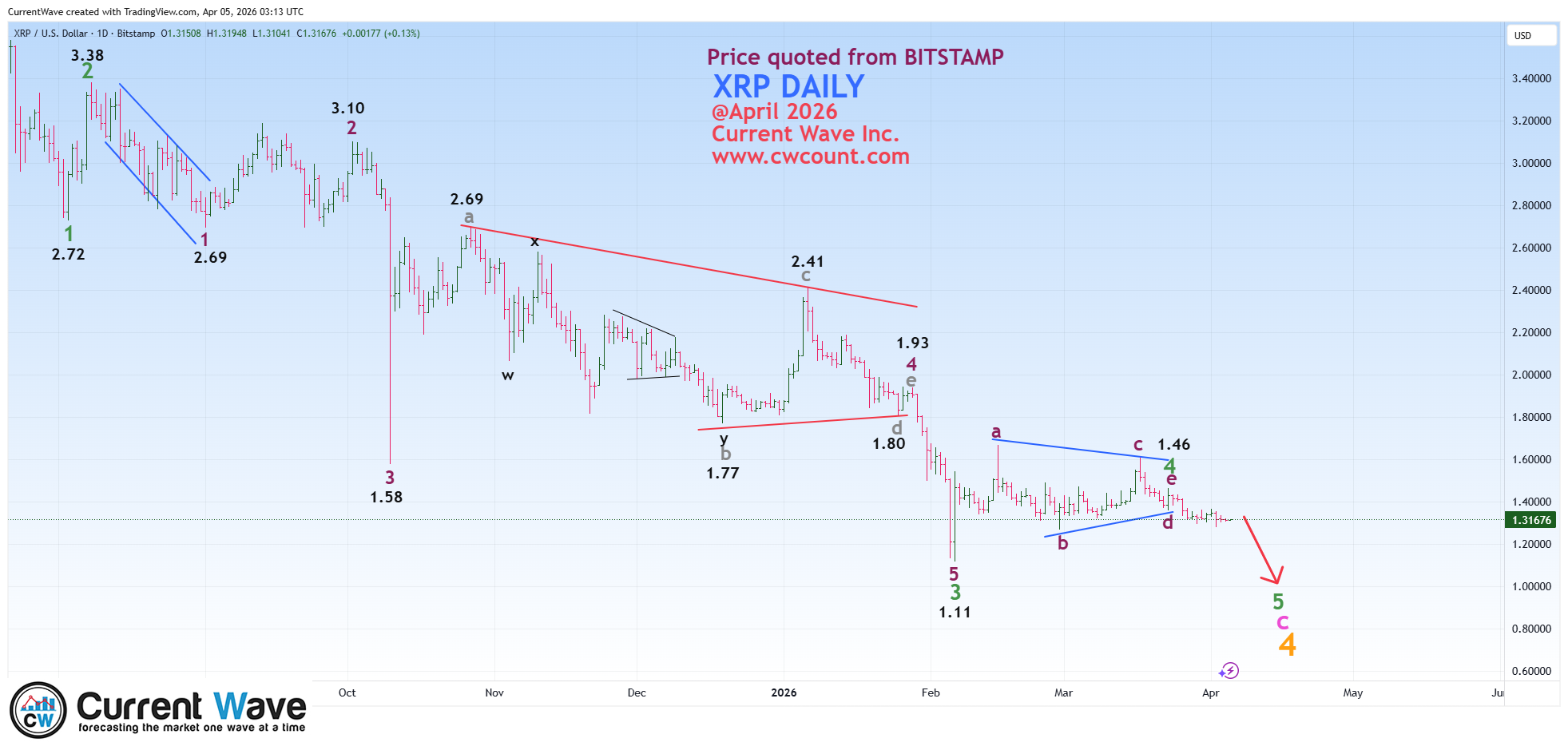
Original commentary · April 4, 2026
“From the triangle peak at 1.46, the price action is unfolding as a series of nested 1-2 setups, indicating that downside pressure is building beneath the surface. This structure typically precedes an impulsive expansion, and if valid, it suggests that a sizable and accelerating decline is likely to follow as the market transitions into a stronger bearish phase.”
June 5 — The Invalidation Line
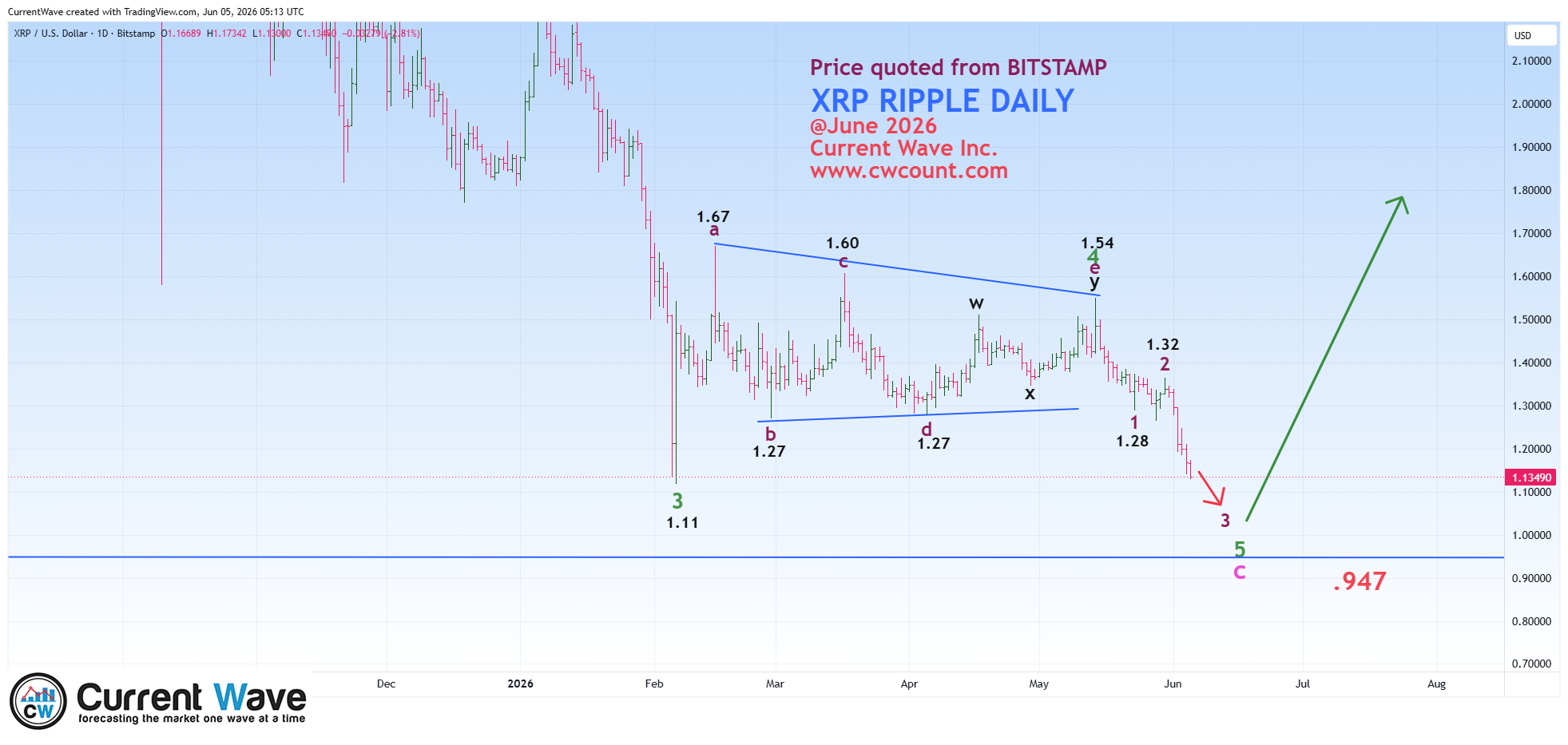
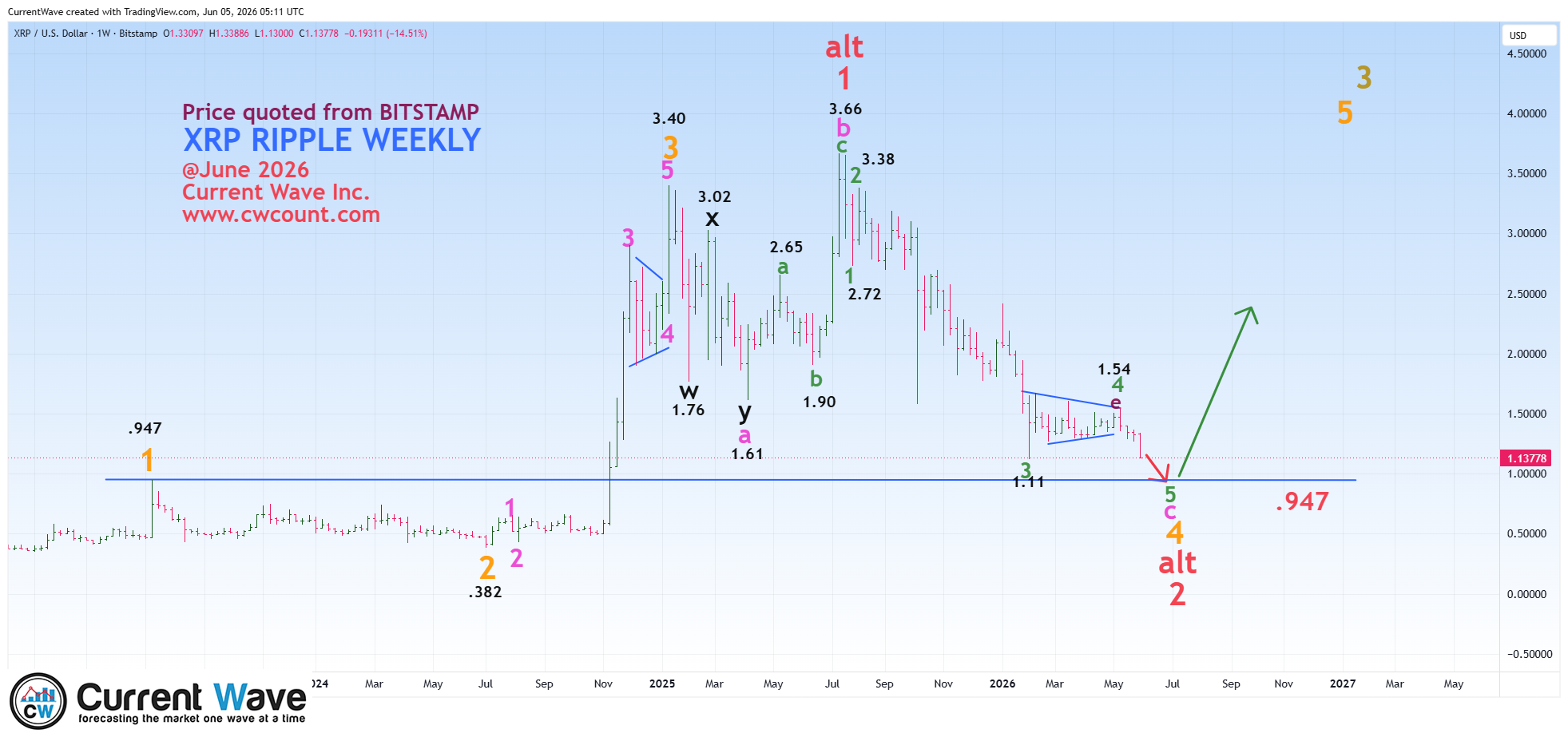
Original commentary · June 5, 2026
“Our preferred count places the completion of the fourth green wave triangle at 1.54, with XRP now progressing through the fifth and final green wave lower. The key invalidation level remains 0.947, as any move below that threshold would overlap the orange wave 1 low, forcing a reassessment of the current wave structure.”
IN PLAIN TERMS — In April, with XRP around 1.31–1.46, the analysis expected an accelerating decline. By June, XRP had fallen to the 1.00–1.05 area. The 0.947 line is the analysis’s own “this is where I would be wrong” level, set in advance. It was never hit — and as of July the structure still awaits resolution in either direction (above 1.18, or below 1.02).
Key levels in this case
1.54 — green wave 4 completion high
1.28 / 1.29 — overlap / alternate-count trigger
1.18 — near-term impulse confirmation trigger
1.00–1.05 — downside completion/review area
0.947 — key invalidation / reassessment threshold
VERDICT · PARTIAL
XRP declined into the 1.00–1.05 completion/review area by June–July 2026. The 0.947 threshold was not broken. As of July 7, the count still awaits confirmation — a break above 1.18 or a decline below 1.02 would resolve the structure.
The Solana case extends the same framework across a longer corrective structure. The focus is not a single price call, but the way key levels, alternate triggers, and completion/review areas were used to follow the structure as it developed.
A Corrective Structure Tracked into Its Completion Area

Original commentary · June 18, 2026
“For now, we continue to maintain our preferred count as long as price remains below the recent high at $76.09. However, a decisive break above $76.09 would increase confidence in the alternate count, implying that Solana may have already established a major cycle low.”
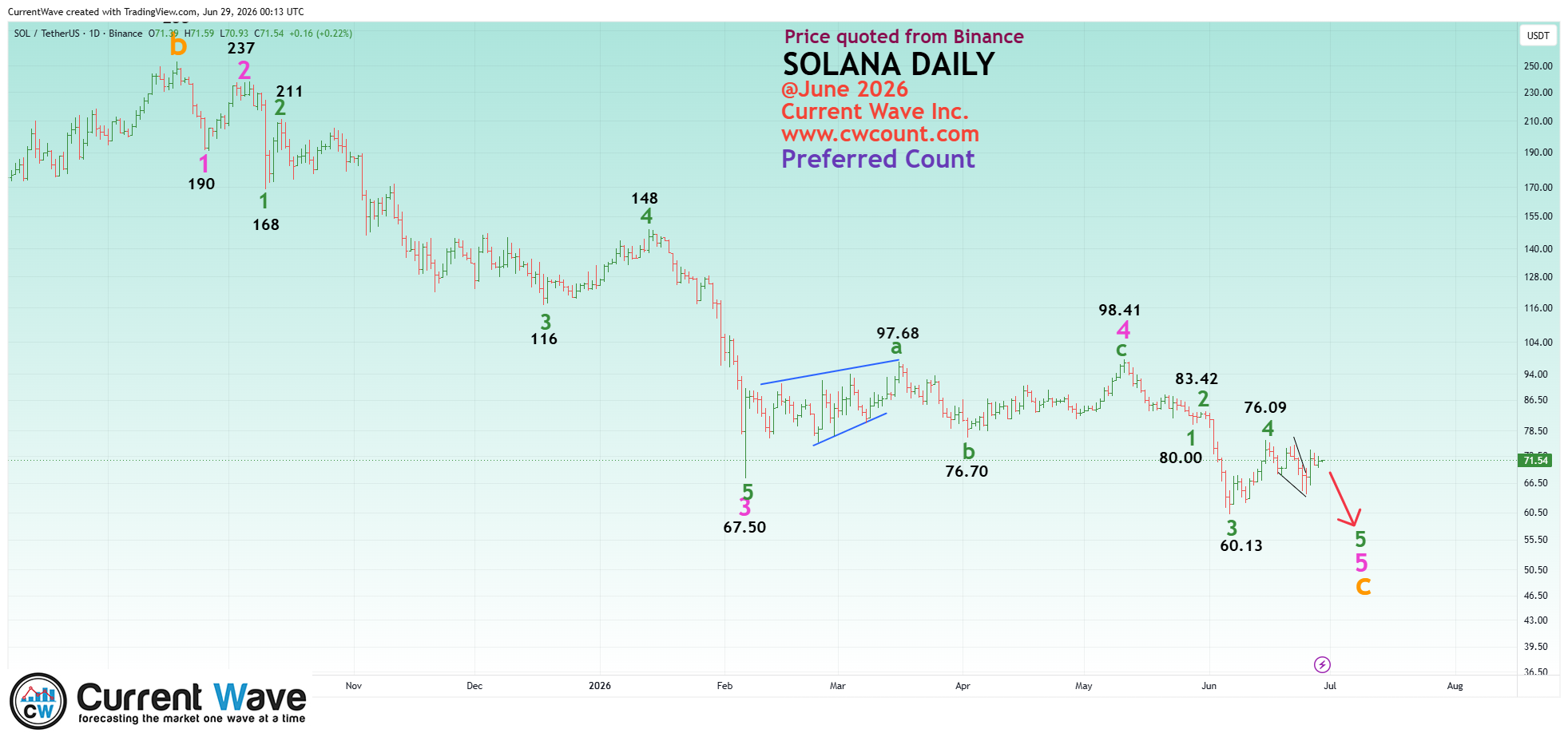
Original commentary · June 28, 2026
“Based on the latest price action, we have reclassified the burgundy Wave 1 as a leading diagonal, while the rally to 73.93 is now labeled as the burgundy Wave 2 correction. Even with this adjustment, our primary expectation remains intact: the green Wave 5 should at least extend below the recent 60.13 low to complete the decline.”
IN PLAIN TERMS — Through June, Solana’s decline was tracked with three levels: staying below 76.09 kept the bearish count valid, 80.00 was the stronger ceiling above it, and 60.11–60.13 was the area where the decline could complete. Price reached that area, and the count then shifted to reading an early recovery — which is exactly why the verdict stays Partial instead of claiming a finished structure.
Key levels in this case
76.09 — 1st key level / alternate trigger
60.11–60.13 — downside completion/review area
83.98 — post-low wave 1 high / early recovery reference
98.41 — larger resistance reference
VERDICT · PARTIAL
SOL’s corrective structure was tracked into the 60.11–60.13 completion/review area before the count shifted into an early post-low recovery structure. The corrective sequence largely played out; the larger recovery structure is not yet confirmed.
What These Cases Show
Across three assets and multiple timeframes, the same method applied: a preferred count with defined levels, an alternate scenario, and an honest review — including where counts were openly revised. On April 14 the previous count was publicly marked invalidated; on June 27 the preferred count was described as “beginning to lose its right look.” No case above is presented as a guaranteed outcome; each is a record of structure-based sequence tracking.
Brian Kim · Chief Analyst · CWCOUNT
Seoul Economy TV weekly live market structure analyst since 2021
Frequently Asked Questions
- What is an invalidation level?
- An invalidation level is a predefined price level that would force a reassessment of the current Elliott Wave count. It marks the point where the preferred interpretation no longer fits the structure as originally framed.
- Why are all cases on this page labeled Partial?
- All cases are labeled Partial because the reviewed structures developed in the expected direction or into the defined review areas, but the larger wave sequences were not fully resolved at review time. CWCOUNT does not label a case beyond what the timestamped evidence can support.
- Is this page investment advice?
- No. This page is an educational review of historical Elliott Wave scenarios and structural levels. It does not tell readers what action to take. It explains how scenarios were framed, monitored, revised, and reviewed.
- What is the difference between a preferred count and an alternate count?
- A preferred count is the main Elliott Wave interpretation being followed at the time. An alternate count is a secondary interpretation that becomes more relevant if price action weakens or invalidates the preferred structure.
- Why does CWCOUNT include revised counts?
- Revised counts are included because market structure changes over time. A transparent review should show when the preferred count remained valid, when it weakened, and when a reassessment became necessary.
Elliott Wave Theory
Basic Tenets
Motive Waves
Corrective Waves
Principle Rules
Fibonacci